Olympia Travel Guide: Walking in the Footsteps of the First Olympians
This post may contain affiliate links, that means if you use the links to purchase something I get a commission at no extra cost to you. Click here for more information about this.
Olympia is one of the most important archaeological sites in Greece. It’s the birthplace of the Olympic Games and where a tradition that has lasted nearly 3,000 years began.
Here, you can literally walk in the footsteps of the very first Olympians.
Of all the ancient sites I’ve visited in Greece, Olympia is my favorite for this very reason. There are plenty of places where you can look at ancient ruins and imagine what life might have been like thousands of years ago. But Olympia feels different.
You can walk through the same entrance athletes once used, stand on the ancient starting line, and even run on the same track where some of the world’s first competitive athletes raced.
Thousands of years later, people are still competing in an event that began right here in this quiet corner of the Peloponnese.
If you’re planning a trip to Greece, here’s everything you need to know before visiting Olympia.
Olympia Travel Guide
Where Is Olympia?
Olympia is located in the western Peloponnese, inland and surrounded by forests and farmland. Unlike many of Greece’s most famous destinations, you won’t find it perched above the Aegean Sea or surrounded by whitewashed buildings.
Instead, the journey takes you into a quieter and greener part of Greece.
It’s approximately:
- 4 hours from Athens by car
- 2 hours from Kalamata
- 1.5 hours from Patras
Because of its location, Olympia is an easy stop to add to a Peloponnese road trip. If you’re already planning to explore places like Kalamata, Nafplio, Ancient Messene, or the mountain villages of the Peloponnese, Olympia is well worth adding to your itinerary.
Why Visit Olympia?
Of all the ancient sites in Greece, Olympia is the one that makes history feel the most alive to me.
It is a UNESCO World Heritage Site and one of the most significant archaeological sites in the world as the literal birthplace of the Olympic Games. But Olympia isn’t just about sports. The site combines history, mythology, religion, athletics, and some pretty incredible scenery.
This was once a major sanctuary dedicated to Zeus, where people traveled from across the Greek world to worship and compete.
And unlike some ancient sites where you’re looking at the remains from a distance, Olympia feels incredibly immersive.
You don’t just see the ancient stadium.
You can walk into it.
You can stand where athletes once stood.
And yes, you can run on the same track.
The History of Olympia
Before the Olympics
Long before the Olympic Games became the massive international event we know today, Olympia was an important religious sanctuary dedicated primarily to Zeus.
Greeks traveled here to worship, participate in religious festivals, and honor the gods. The athletic competitions that eventually became the Olympic Games were originally part of these religious celebrations.
So, while today we might think of the Olympics as one giant sporting event, their origins were much more connected to religion and worship.
The First Olympic Games
The ancient Olympic Games are traditionally believed to have begun in 776 BC.
Unlike the Olympics today, the original competitors were all Greek men, although they came from different city-states and regions across the Greek world.
Even though these groups didn’t always get along—and were sometimes actively at war—they came together in Olympia for one major athletic competition.
A sacred truce was established during the games so that athletes and spectators could travel safely to and from Olympia. For a brief period, people were expected to put their conflicts aside.
Honestly, the idea of everyone agreeing to pause their differences for one giant sporting event feels like something we could probably use a little more of today. Though the truce is technically still in effect, it is merely symbolic today and unfortunately isn’t always followed.
The ancient games also looked quite different from the Olympics we know now. One fun—or maybe slightly awkward—fact is that many ancient athletes competed naked. Married women were generally not allowed to attend the competitions, although there were exceptions connected to religious roles.
The Olympics were definitely a different experience back then.
How the Games Changed
Over time, the Olympic Games grew, and more events were added. What began as a relatively simple competition eventually included running, wrestling, boxing, chariot racing, and other athletic events.
The ancient Olympic Games continued for more than 1,000 years before coming to an end in the late 4th century AD.
More than 1,500 years later, the Olympic tradition was revived with the first modern Olympic Games in Athens in 1896.
And while today’s Olympics look very different from the ancient version, it is pretty incredible to think that the tradition can all be traced back to this one place.
What to See at Olympia
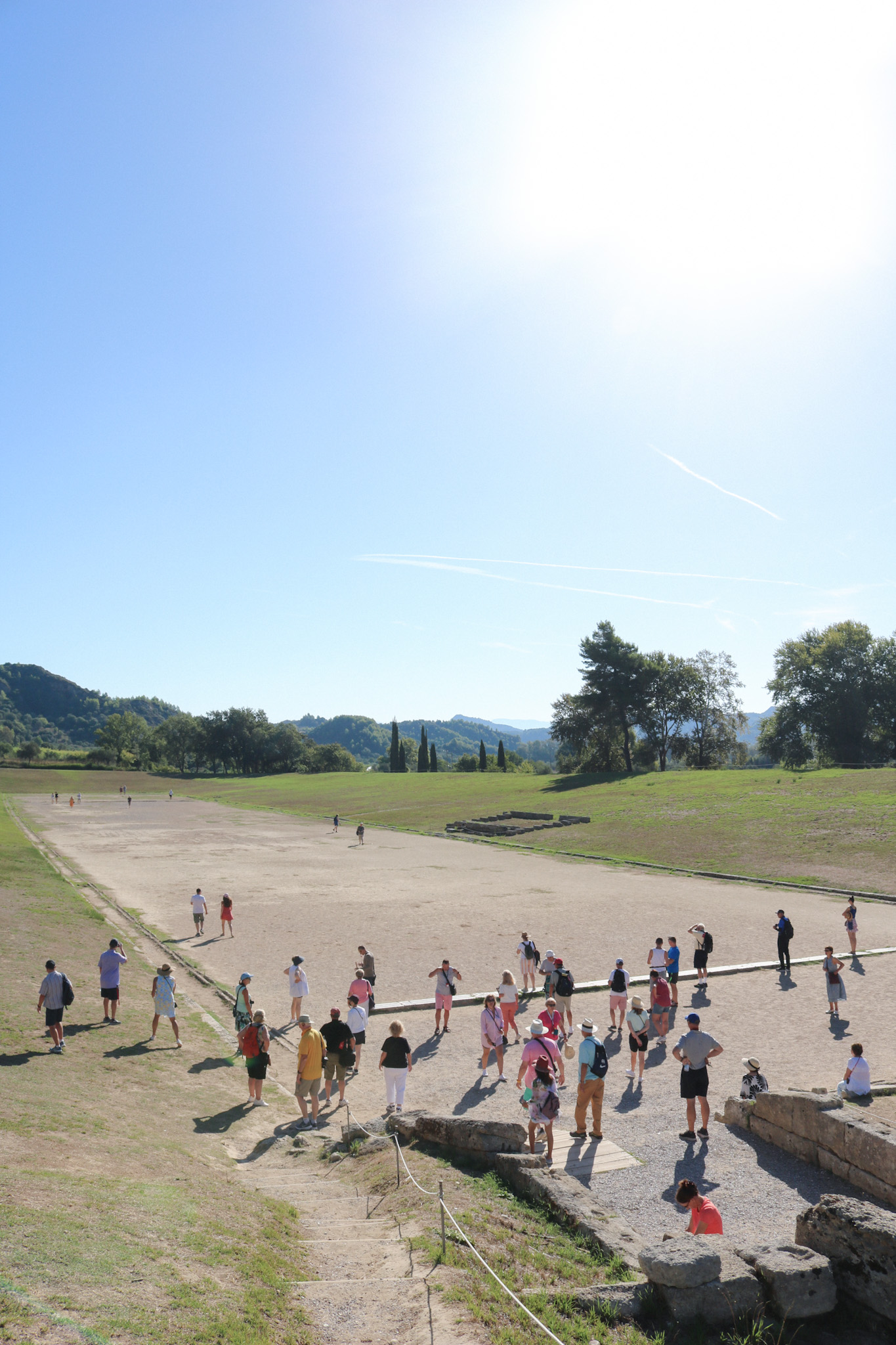
Ancient Stadium
In my opinion, this is the main highlight of Ancient Olympia.
You enter the stadium through a long arched passageway that immediately makes the experience feel a little more dramatic.
Then you emerge into the open stadium, where you can still see the starting and finish lines and the large grassy embankments where spectators once gathered to watch the events.
This is one of the reasons Olympia feels so immersive compared to other ancient sites.
You aren’t standing outside the stadium looking at it from behind a rope.
You’re actually inside it.
And if you want to, you can run the same race that Olympic athletes did thousands of years ago.
Every time I visit Olympia, running on the track is my favorite part. There is something about standing on that starting line and then taking off down the track that makes history feel incredibly close.
For a few seconds, you can pretend you’re an Olympian.
Minus the thousands of spectators and, thankfully, the requirement to compete naked.
Temple of Zeus
The Temple of Zeus was once the centerpiece of Olympia and one of the most impressive buildings in the ancient Greek world.
It was also home to the famous Statue of Zeus, a massive gold and ivory statue created by the sculptor Phidias. The statue was considered one of the Seven Wonders of the Ancient World.
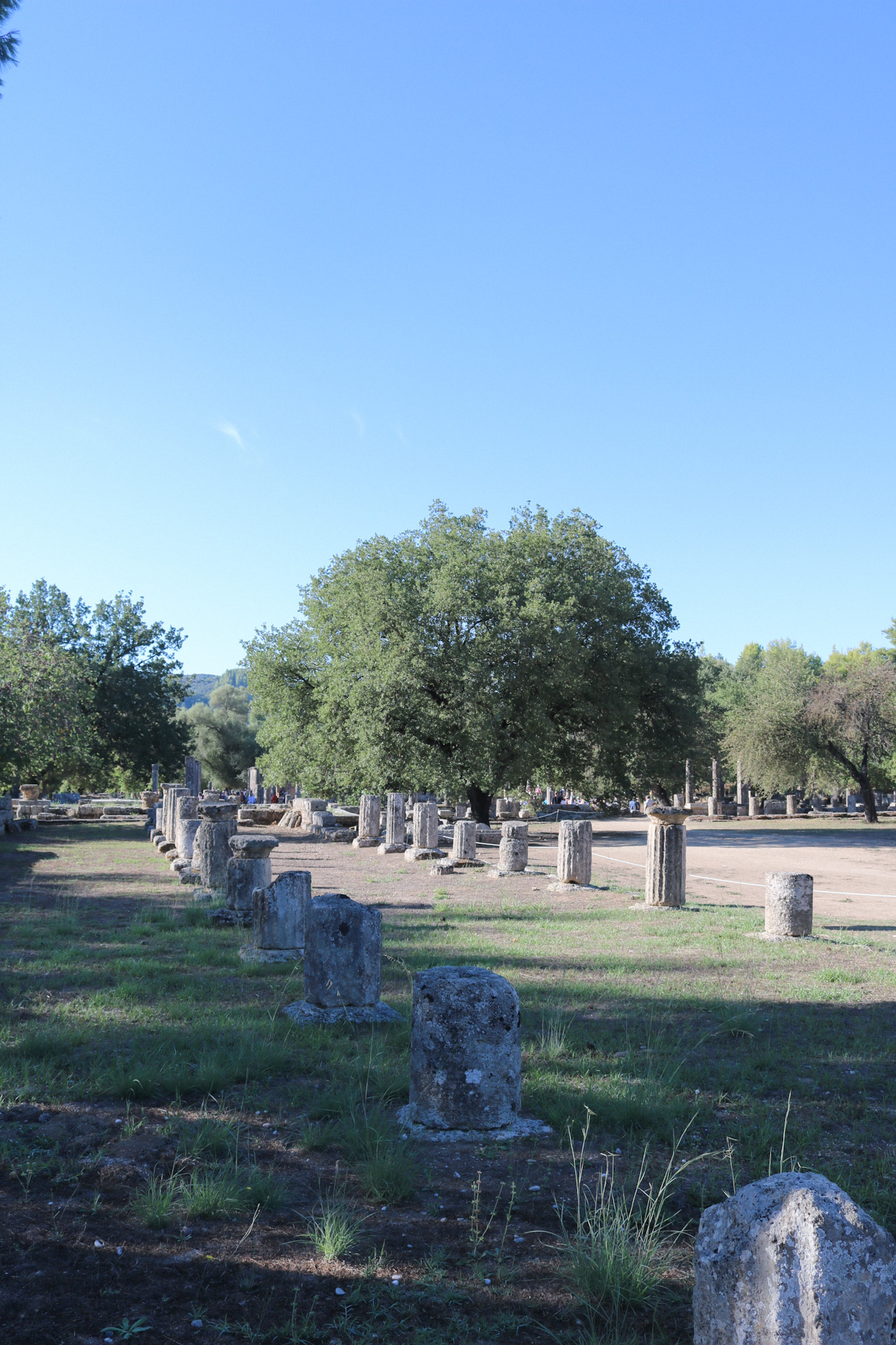
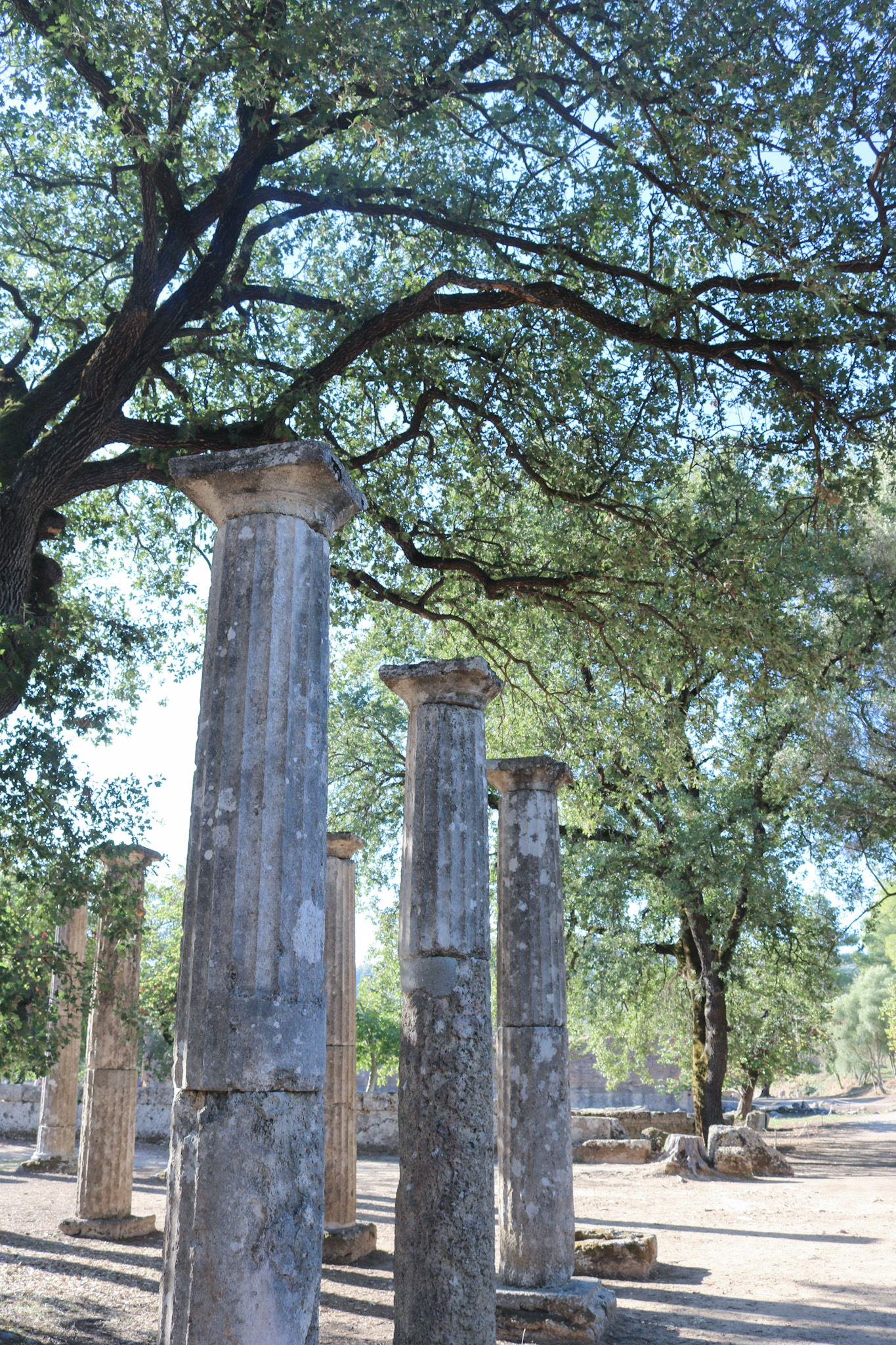
Today, the temple is in ruins, but you can still see its enormous foundations and columns and get a sense of just how impressive the structure once was.
I like to think of it as being similar to what the Parthenon is to the Acropolis in Athens: one of the site’s most important and recognizable buildings.
Temple of Hera
The Temple of Hera is one of the oldest temples in Greece and was dedicated to the goddess Hera, the wife of Zeus.
Today, it has an important connection to the modern Olympic Games. The Olympic flame lighting ceremony takes place here before each Olympic Games, continuing the connection between the ancient sanctuary and the modern tradition.
It’s a pretty incredible reminder that even though thousands of years have passed, Olympia is still connected to the Olympics today.
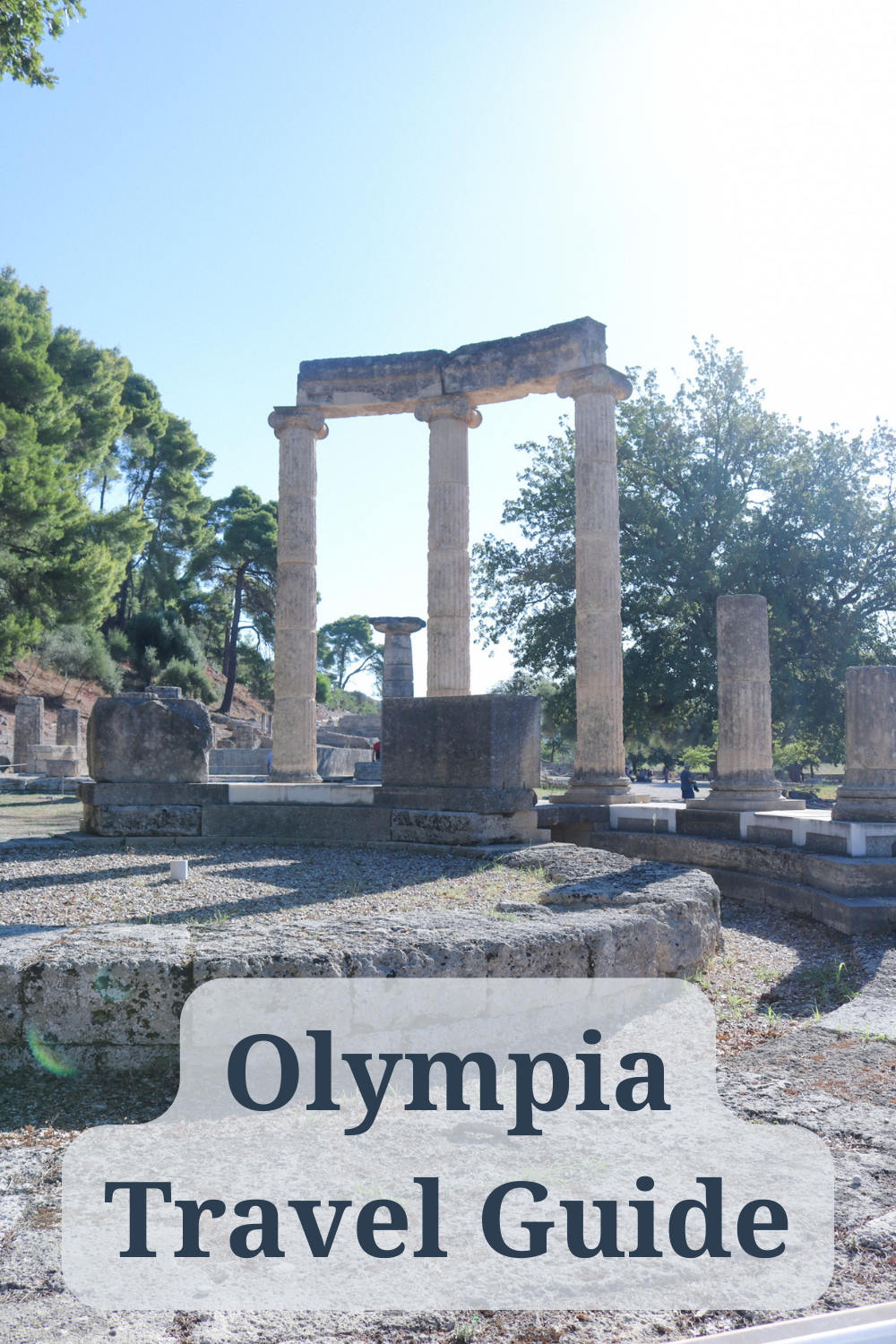
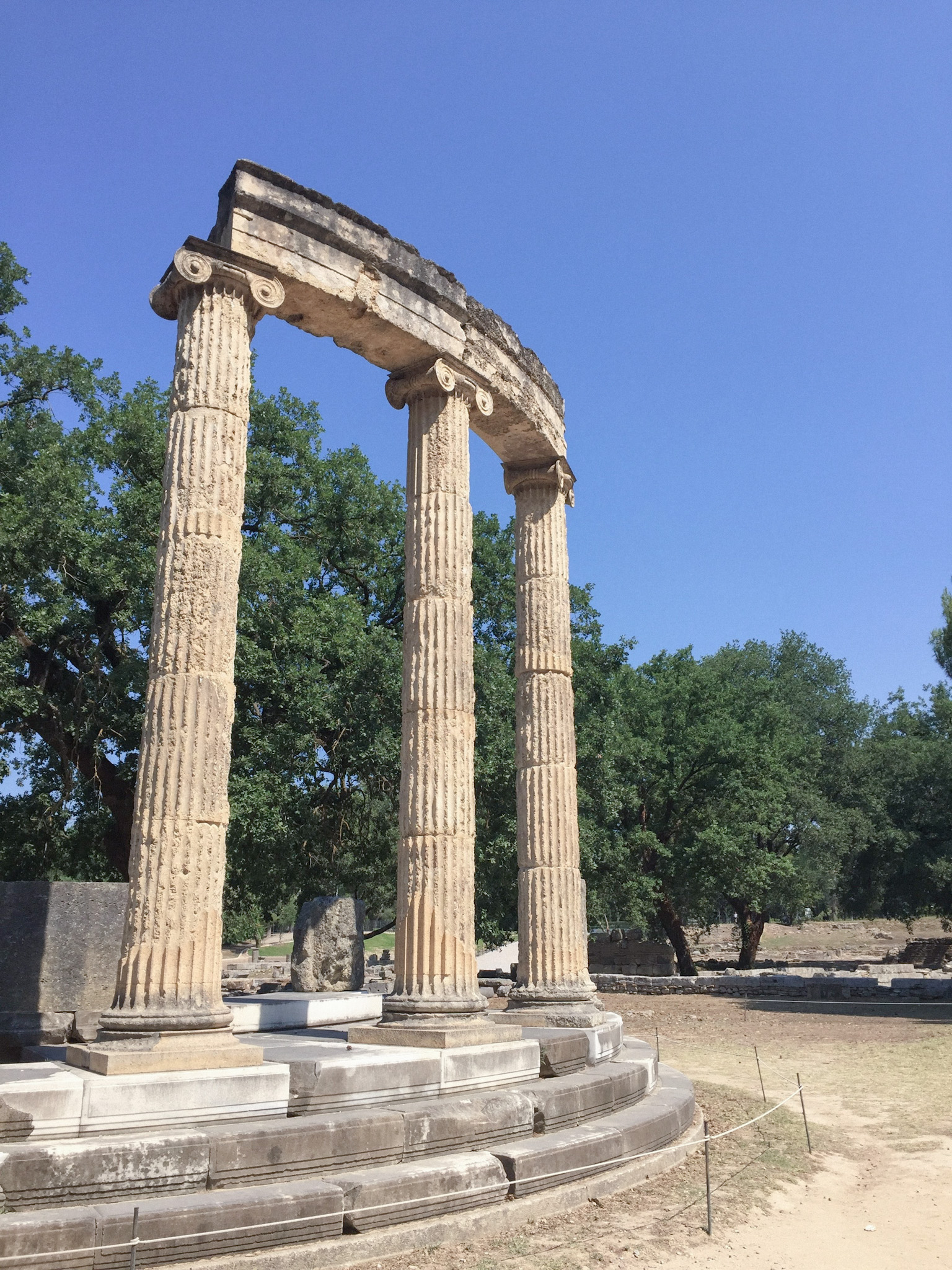
Philippeion
The Philippeion is one of the more unique buildings at Olympia because of its circular shape.
It was begun by Philip II of Macedonia and later completed by his son, Alexander the Great. The monument honored members of Philip’s family and was one of the few structures in the sanctuary dedicated to people rather than gods.
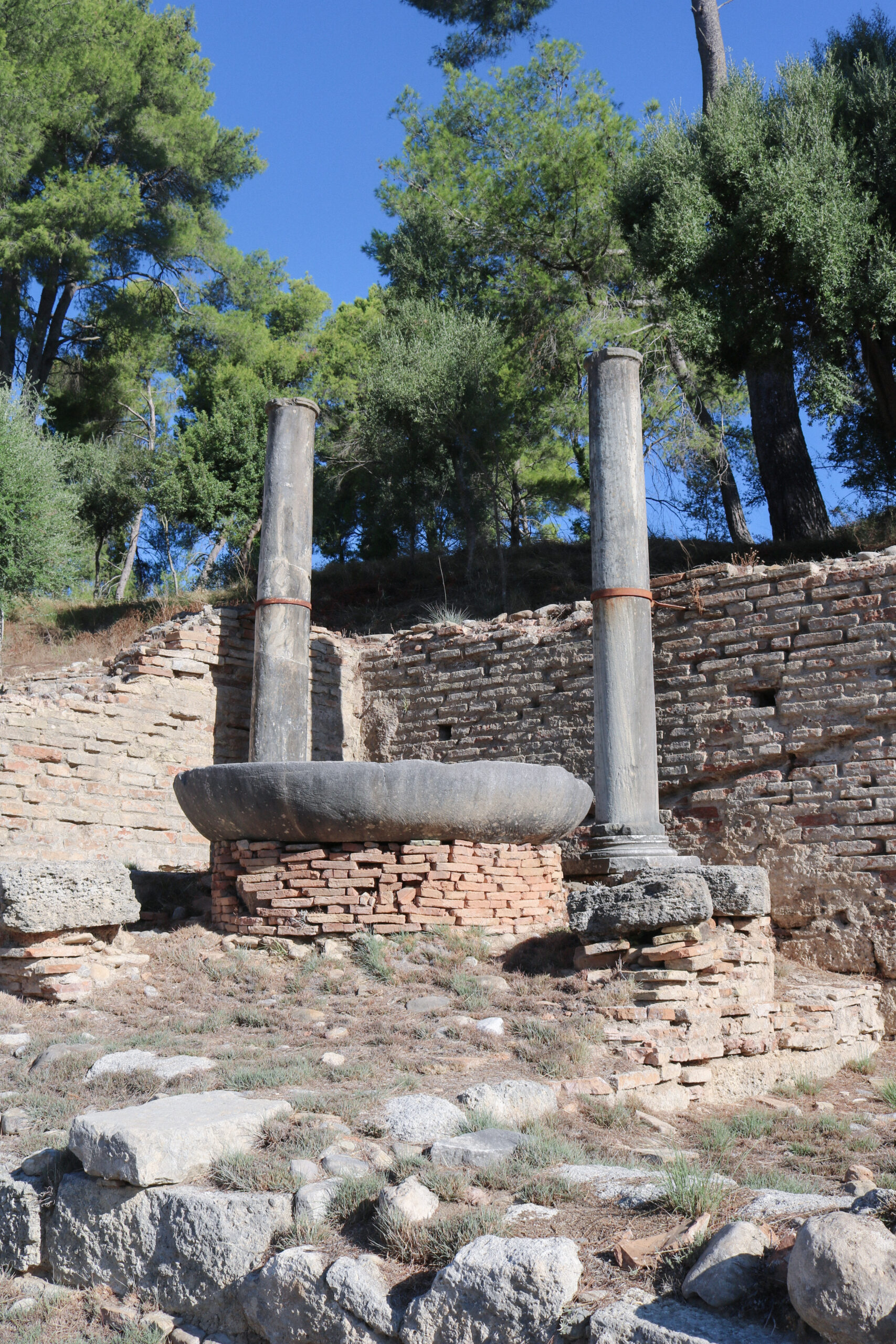
Gymnasium and Palaestra
The gymnasium and palaestra were important parts of athletic training at Olympia.
This is where athletes prepared for competitions, trained, and practiced events such as wrestling and other physical activities.
When you’re walking around Olympia, it’s easy to focus entirely on the stadium, but these areas help tell the bigger story of what it took to actually compete in the ancient games.
The athletes didn’t just show up, run one race, and go home.
Olympia was a major athletic and religious center with spaces dedicated to training and preparation.
Grab your FREE
✨Ultimate Greece Travel Starter Guide!!!✨
 Skip the overwhelm — I pulled together the must-knows so you don’t have to dig through a million sites.
Visit the Archaeological Museum of Olympia
After exploring the archaeological site, I highly recommend visiting the Archaeological Museum of Olympia.
I like doing the museum after walking through the ruins, similar to how I recommend visiting the Acropolis Museum after seeing the Acropolis in Athens. Seeing the site first gives you context, and then the artifacts in the museum help bring everything you just walked through to life.
You’ll see sculptures and artifacts discovered at Olympia, including pieces from the Temple of Zeus and the famous statue of Hermes attributed to Praxiteles.
And if you’re visiting during the summer, it is also a great opportunity to cool off in the air conditioning.
History and a break from the Greek summer heat? I’ll take it.
Best Time to Visit Olympia
Olympia can be visited year-round, but the experience will be very different depending on when you go.
Spring
Spring is one of the best times to visit Olympia. The weather is generally comfortable, the surrounding landscape is greener, and it isn’t as busy as the peak summer months.
If you can visit before the summer heat arrives, you may have a much more enjoyable experience walking around the large archaeological site.
Fall
Fall is another great option, especially once the peak summer crowds and hottest temperatures have started to disappear.
The weather is usually much more comfortable for exploring, and you’ll still have plenty of daylight for sightseeing.
Summer
Summer is the busiest and hottest time to visit.
Olympia is inland, and there are large sections of the archaeological site with very little shade, so it can get extremely hot in the middle of the day.
If you’re visiting in summer, try to arrive right when the site opens. You’ll have cooler temperatures and hopefully fewer people around.
Winter
Winter is the quietest time to visit Olympia.
You may have cooler or rainy weather, but you’ll also find fewer crowds and a much more peaceful experience. If you don’t mind wearing a jacket and checking the forecast, winter can be a great time to explore.
Rent a Car
In my opinion, renting a car is the best and easiest way to visit Olympia.
This is how I have always traveled there. Having your own car gives you the freedom to explore at your own pace and makes it much easier to include Olympia as part of a larger Peloponnese road trip.
You can stop in smaller towns along the way, combine your visit with other destinations, and avoid worrying about bus schedules and transfers.
Take a Guided Tour from Athens
If you don’t want to rent a car, a guided tour from Athens is another option.
This can be a good way to knock Olympia off your Greece bucket list without having to navigate the drive yourself. Depending on the tour, you may also be able to combine Olympia with other stops along the way.
Just keep in mind that it is a long day from Athens (about a 4-hour ride between Olympia and Athens).
Public Transportation
It is possible to reach Olympia using public transportation, but it is definitely less convenient.
Depending on the route and schedule, you’ll likely need to travel from Athens to another major transportation hub, such as Patras, before continuing on to Olympia.
It can be done, but it involves multiple transfers and requires more planning than simply renting a car.
If you have limited time in Greece, I would personally choose a rental car or guided tour instead.
Grab your FREE
✨Ultimate Greece Travel Starter Guide!!!✨
Skip the overwhelm — I pulled together the must-knows so you don’t have to dig through a million sites.
Tips for Visiting Olympia
Buy the Combined Ticket
The archaeological site and museum are both worth visiting, so look into the combined ticket option rather than choosing just one.
The ruins tell one part of the story, while the museum fills in many of the missing pieces.
Wear Comfortable Shoes
Olympia is a large archaeological site with plenty of walking.
Also, you may suddenly find yourself wanting to run on the ancient Olympic track, so take that into account when choosing your shoes.
I’m not saying you have to race your travel companions.
But I’m also not saying you shouldn’t.
Visit Early or Late
The best way to avoid the strongest heat and biggest crowds is to arrive early in the morning or later in the day.
If possible, I recommend getting there right when the archaeological site opens, especially during summer.
Bring Water
Bring water with you, particularly during the warmer months.
Olympia is inland, it gets hot, and there are large sections of the archaeological site without much shade.
You don’t want your Olympic experience to end with you dramatically collapsing before you even reach the stadium.
Give Yourself at Least 3–4 Hours
I would give yourself at least three to four hours minimum to experience Olympia properly.
Plan around two to three hours for the archaeological site and another hour or two for the museum, depending on how much time you like to spend reading exhibits and looking at artifacts.
You could rush through Olympia faster, but this is one place where I don’t think you should.
Is Olympia Worth Visiting?
Absolutely.
Thousands of years separate us from those first athletes, but standing on that starting line somehow makes history feel incredibly close.
Every time I visit, I leave inspired—not just by what people accomplished back then, but by how one tradition that started in this quiet corner of Greece grew into something the entire world celebrates today.
There are ancient sites in Greece where you can admire beautiful temples, impressive ruins, and artifacts that have survived for thousands of years.
Olympia gives you something a little different.
You can participate in the experience.
You can walk through the same entrance as ancient athletes. You can stand on their starting line. And you can run down the same track where a tradition that would eventually become the modern Olympic Games began.
For me, that’s what makes Olympia so special.
It’s not just a place where you look at history.
It’s a place where, even if only for a few seconds while running down an ancient track, you feel like you’re part of it.
Have you ever visited Ancient Olympia?
Let me know↓🥰